
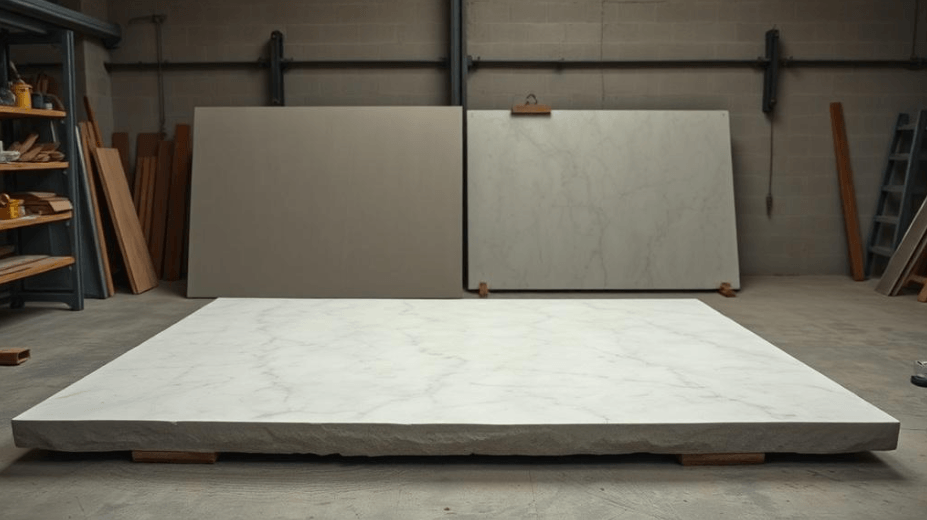

For countertop quoting software, the useful answer lives in the shop floor details: slab photos, measurements, install constraints, and whether the team can trust the number before anyone starts fabricating stone.
Last fall I was standing in a 4,200-square-foot fabrication shop in Grand Rapids, watching the owner, Steve, try to quote a builder’s 14-unit multifamily job on a shared Google Sheet while his salesperson fielded three phone calls. Steve had the material cost for Calacatta Laza wrong by $4 a square foot because someone had updated the sheet two months late. He didn’t catch it until the builder had already signed. That one job bled about $6,800 in margin. Not catastrophic, not fatal, but the kind of slow bleed that, repeated forty times a year, turns a profitable shop into one that’s just paying its bills. Steve’s problem wasn’t laziness or incompetence. It was that his quoting process was held together with duct tape, and nobody had forced it into a real system.
That story is common enough to be boring. But the boring truth is what separates shops making money from shops making excuses.
What Quoting Actually Is (and Why Shops Get It Wrong)
Countertop quoting and estimating is the function that converts a customer’s vague kitchen renovation dream into a signed contract with a price you can actually defend when the dust settles. It touches material selection, square footage measurement, edge profiles, cutout count and complexity, sink and faucet specs, seam placement, and overhead allocation. Every one of those variables is a place where money leaks out if you’re sloppy.
The median residential customer in 2026 compares 2.4 shops before signing. The shop that delivers a quote inside 24 hours wins disproportionately. Mid-sized residential shops quote between 35 and 90 jobs per week, with average quote time running 14 to 38 minutes per job depending on tools. Conversion rates range from 14 percent in undertrained operations to 38 percent in disciplined ones.
Here’s the part most owners miss: quoting isn’t just a sales function. A clean quote is a production planning input. It tells the shop floor exactly what to template, nest, cut, and install. A sloppy quote forces your fabricators to interpret the customer’s intent on the fly. That interpretation costs you money on every single job. It’s like handing someone a recipe with half the measurements missing and expecting the dish to come out the same way twice.
The Five-Step Workflow That Actually Works
A disciplined shop runs five steps from inquiry to signed contract. Nothing exotic about it, but the discipline is where shops diverge.
Inquiry capture. Customer name, contact, job site, material preference, rough square footage. Integrated platforms pull this from web forms, phone intake, or in-person showroom visits. Shops still copying this onto sticky notes are already behind.
Material selection. Walk the customer through stone categories, available slab inventory, and price tiers. Shops with a clean, updated material reference document close more often because the salesperson can set expectations without guessing. (This is where Steve’s outdated spreadsheet killed him.)
Square footage and complexity. Initial measurement, edge profile selection, cutout count, sink and faucet variables. Remote quotes typically hold within 6 to 12 percent of final pricing. Post-template quotes hold within 2 to 4 percent. That gap matters: on a $12,000 kitchen, a 10 percent miss is $1,200 you either eat or argue about.
Pricing calculation. Material cost, labor allocation, edge profile cost ($9 to $42 per linear foot depending on complexity and material), cutout cost ($90 to $260 per cutout depending on sink type), install cost, and overhead. Integrated platforms run this calculation in 12 to 22 minutes per quote. Spreadsheet shops spend 35 to 60 minutes and still get it wrong more often.
Quote delivery and signature. Formal proposal, payment terms, signed agreement. Get it out in under 24 hours and you close 22 to 38 percent of inbound leads. Wait three days and that drops to 9 to 15 percent. The math here isn’t subtle.
The Numbers That Should Keep You Up at Night
I’ll lay out the operational specs because this is where opinions stop and math starts:
- Quote turnaround target: 4 to 24 hours
- Quote-to-close conversion: 22 to 38 percent (disciplined) vs. 9 to 15 percent (3-day turnaround)
- Quote time per job: 12 to 22 minutes on integrated platforms; 35 to 60 minutes on spreadsheets
- Post-install margin variance: under 5 percent in disciplined shops; 10 to 18 percent in spreadsheet shops
- Square footage measurement variance between rough and template: 7 to 11 percent on irregular kitchens
- Common platforms: Moraware Systemize, StoneApp, ActionFlow, Slabwise
- Platform subscription range: $99 to $799 per month
The ROI shows up in three places.
Conversion. The delta between quoting in 24 hours and quoting in 3+ days is worth up to $420,000 in additional annual revenue at a mid-sized residential shop, based on case studies.
Margin protection. Holding post-install margin variance under 5 percent preserves up to $180,000 in annual gross margin compared to shops running 10 to 18 percent variance.
Time. Cutting quote time from 50 minutes to 18 minutes per job at 60 quotes per week saves the equivalent of one full-time admin role per year.
That last one is the one owners feel in their gut. You don’t hire another person. You just stop drowning.
Platform Choice Matters Less Than You Think
Here’s my genuinely held opinion after running multi-location fabrication P&Ls: the platform you pick matters far less than the workflow discipline you enforce behind it. A shop quoting inside 24 hours on Moraware Systemize will outperform a shop running Slabwise with a 3-day turnaround, and vice versa. The tool is a lever. Discipline is the hand on the lever.
That said, the tool categories are real and the differences aren’t trivial.
Spreadsheet-based quoting is still common at small shops. Quote time runs 35 to 60 minutes, turnaround commonly stretches to 2 to 5 days, and you’re losing business to faster competitors whether you realize it or not.
Generic CPQ platforms (Salesforce CPQ, HubSpot CPQ) handle quote generation but lack stone-specific material libraries, slab inventory integration, and the templating handoff that residential stone shops actually need. Trying to force Salesforce CPQ to understand a 3cm Taj Mahal quartzite slab yield is like using a sledgehammer to set a backsplash tile.
Vertical stone shop platforms (Moraware Systemize, StoneApp, ActionFlow, Slabwise) ship with stone-specific material libraries, slab inventory integration, and templating handoff built in. They’re purpose-built, and that’s where the 12-to-22-minute quote time comes from.
For readers who want the full operational comparison, [https://slabwise.com/guide/countertop-quoting-software](https://slabwise.com/guide/countertop-quoting-software) covers the countertop quoting and estimating workflow end to end.
Getting It Running: 60 to 120 Days, Three Phases
Implementation at a typical residential shop isn’t a weekend project, but it’s not a year-long ordeal either.
Phase 1: Platform selection (weeks 1 to 3). Trial 2 to 3 vertical platforms. Sign the one that fits your workflow and price tier. Don’t overthink it. The best platform is the one your salespeople will actually use.
Phase 2: Data migration (weeks 2 to 7). Customer records, slab inventory, and material pricing move into the new platform. This is the long pole. It routinely runs 2 to 5 weeks, and the shops that rush it regret it when their pricing tables are wrong on day one.
Phase 3: Training and discipline (weeks 4 to 12). Salespeople and templators learn the new workflow. The owner sets a 24-hour quote turnaround standard and tracks quote-to-close conversion weekly. Most shops see measurable conversion lift within 90 days of go-live, based on case studies. The catch is that the owner has to actually enforce the standard. A posted policy nobody follows is just wallpaper.
The Safety Sidebar Nobody Reads (But Should)
Stone shop operations carry standard manufacturing safety considerations. Slabs commonly weigh 600 to 900 pounds at 56 by 120 inches in 3cm thickness. Vacuum lift handling, forklift operation in slab yards, and manual handling of finished sections are all governed by OSHA general industry standards.
More critically, stone fabrication generates respirable crystalline silica dust on any cutting or grinding operation. OSHA 29 CFR 1926.1153 sets the permissible exposure limit at 50 micrograms per cubic meter as an 8-hour time-weighted average. This isn’t a quoting issue, but every owner reading a quoting article should remember that the production floor those quotes feed operates under that standard.
Owners weighing major operational changes (platform purchases, equipment investments, multi-location expansion) benefit from a trade-experienced consultant or peer review before committing capital. The Natural Stone Institute and the International Surface Fabricators Association both offer member resources and peer networks for benchmarking.
Frequently Asked Questions
Q: How accurate are remote quotes versus in-shop templating quotes? A: Remote quotes commonly run 6 to 12 percent off final job pricing, while post-template quotes hold within 2 to 4 percent.
Q: What software do most stone shops use for quoting in 2026? A: Moraware Systemize, StoneApp, ActionFlow, and Slabwise are the most cited platforms in trade buyer research.
Q: How does quoting accuracy affect post-install margin? A: Shops with disciplined quoting hold post-install margin variance under 5 percent. Spreadsheet shops commonly see 10 to 18 percent swings.
Q: What is the most common quoting mistake in undertrained shops? A: Underestimating cutout count and complexity on irregular kitchens is the most common source of margin loss.
Q: How long should a quote take to produce? A: Disciplined shops produce quotes in 12 to 22 minutes per job on integrated platforms; legacy spreadsheet workflows run 35 to 60 minutes.
Q: Is faster quoting really worth paying for a platform subscription? A: At 60 quotes per week, cutting quote time from 50 to 18 minutes saves the equivalent of one full-time admin role per year. The subscription pays for itself many times over.
Q: When should a shop consider switching from spreadsheets to a vertical platform? A: Once you’re quoting more than 20 jobs per week consistently, the time loss and margin variance from spreadsheet quoting become expensive enough to justify the switch.
Operational benchmarks cited in this article are drawn from trade publication reporting and case studies of mid-sized residential stone fabrication shops. Results vary by shop size, market, and operational discipline.
